Preparation tips
Before you leave – Your Preparation Checklist at a Glance
1. Practical Arrangements

Good preparation will help you stay organised and take care of important formalities in good time. Especially before an internship abroad, there are quite a few things to arrange – from important documents and deadlines to coordinating with your home university and internship host organisation, as well as practical questions about your travel.
Our tip: Start preparing as early as possible. This will leave you enough time to request any documents you may still need, make appointments or make changes at short notice.
2. Finances

An internship abroad is a valuable experience – but it can also involve additional costs. In addition to Erasmus+ funding, there are other ways to finance travel, accommodation and living expenses.
Our tip: Get an early overview of your income and expenses to realistically assess how much funding you will need.
Scholarships are generally not guaranteed. It is still worth applying, but you should not rely on receiving funding. Therefore, plan for alternative sources of funding and structure your finances around several different sources whenever possible.
What costs should you plan for?
Before Departure
- Visa and, if applicable, residence permit
- Passport or other required documents
- Insurance
- Vaccinations and, if applicable, medical certificates
- Travel to your internship destination
- Flight, train or bus tickets
- International driving licence, if required
- Initial accommodation and/or security deposit
- Necessary purchases for your stay
During your stay
- Rent and utilities
- Food and everyday expenses
- Local public transport
- Phone and internet
- Leisure and personal expenses
- Costs for visa, residence or registration formalities, if applicable
Getting there - Go Green!
One focus of the new Erasmus+ program generation is on "Green Erasmus" - for example by supporting an environmentally friendly and sustainable way of traveling. KOOR - Erasmus Services BW has already been promoting green travel to the destination country with a travel allowance since 2020. But a sustainabe Erasmus+ stay means much more than just a green arrival and departure. You can find more tips and information on how to make your stay abroad as sustainable as possible in the document “Your sustainable stay abroad with Erasmus+”.
How do I apply for additional funding for green travel?
When registering in Placement Online, you indicate whether you want to travel to the destination country "green" and enter this in the registration mask. Bicycles, long-distance buses, trains or shared rides* on the outward and/or return journey count as “green” means of transport.
As soon as you are registered, you can submit the "Declaration of Honour for Green Travel". With this declaration, you commit to a green arrival or departure before the start or after the end of your internship. Tickets from visits home during the internship will not be accepted as proof of green travel.
Depending on the distance and means of transport, you will receive up to 6 additional travel days subsidised (max. € 25 / day, depending on the destination country)
The following applies to stays that start on Augst 1st, 2024 or later (for study visits from winter term 24/25):
| Distance | Train, Long-distance Bus, Carpooling | Distance | Bike |
| < 500 km | 2 travel days | < 100 km | 2 travel days |
| 500 - 999 km | 3 travel days | 100 - 149 km | 3 travel days |
| 1000 - 1499 km | 4 travel days | 150 - 199 km | 4 travel days |
| 1500 - 2000 | 5 travel days | 200 - 250 km | 5 travel days |
| > 2000 km | 6 travel days | > 250 km | 6 travel days |
Here are some suggestions for your green travel:
- Train tickets - can be booked via Deutsche Bahn (e.g. Interrail tickets) or directly via the train company in your destination country (often cheaper)
- Bus travel - Long-distance bus providers also travel to destinations abroad. Bus travel takes a bit longer, but is often a very affordable option, for example with Flixbus
- Driving a car - Maybe a fellow student is spending his or her study abroad in the same destination country or city as you? Join forces and travel together in one car. This saves costs, is less boring and in the process even more sustainable than if everyone sits in their own car and drives alone.
- Carpooling - No one from your college/university is going to the same country? No problem. Alternatively, you can look for rideshare drivers on popular sites like blablacar or find a ride yourself.*
You will travel to an island that is not reachable by a "green" option? Then you will probably choose a classical trip by plane: When comparing prices, a look at Skyscanner.com helps.
*Only booked rides will be accepted as carpool proof
Reimbursement of extraordinary costs for expensive travel
These costs will be approved if you can prove that the travel allowance (Short term, Eramsus+ worldwide*, staff mobility) does not cover at least 70% of the travel costs. If the extraordinary costs for expensive travel are approved, they replace the travel allowance. The application must be submitted in writing to erasmus.koor@h-ka.de 6 weeks prior to the trip. The extraordinary costs for expensive travel can cover up to 80% of the total cost of the trip.
The following documents are required: Proof of payment of the associated costs based on invoices showing the name and address of the invoice issuer, the amount and currency, the invoice date and the travel route.
*except for countries in region 13 and 14

Residence and entry requirements
As a German citizen, you can find information on residence regulations abroad on the website of the Federal Foreign Office and on the website of the relevant embassy.
If you do not have German citizenship, it is best to inform yourself on the website of the embassy of the destination country about the residence and entry requirements for your nationality.
In any case, find out in good time - if a visa is necessary, the application has to be expected with a (time-) effort. If required, KOOR will be happy to issue a certificate of the funding period and the amount of the scholarship in German or English for your visa application.
UK Visa:
Due to Brexit, we can no longer support you in applying for the Certificate of Sponsorship (CoS) for stays in the UK. There are now private agencies (e.g. BUNAC or ESPA) that help you applying for a CoS and support you with your visa application. Please check these offers carefully and find out in advance about the costs for the CoS and the visa.
Research internships and study semesters lasting less than 6 months are currently exempt from the visa requirement.
Funding
A stay abroad is of course always associated with costs. But so that the stay does not fail because of the financial hurdle, there are various ways to earn some extra money:
- ERASMUS+ funding: Information on the funding conditions can be found under the appropriate tabs on this website.
- Funding conditions for a study abroad
- Fellowship requirements for an internship abroad
- Funding conditions for a staff mobility
- Auslandsbafög - more information directly on the website of BAföG
- Children's allowance: Are you between 18 and 25 years old? Then you are still entitled to child benefit under certain conditions. You can find information on the website of the Agency for Employment
- (Mini) Jobs
- Before the stay abroad in the home country, for example, in the supermarket, as a Hiwi, in the catering trade, in retail.... Here there are very many opportunities.
- During the stay abroad, for example, a mini-job in the destination country (Attention, not everywhere you may work as an exchange student without a visa - please inform in advance!)
- In internship abroad - with luck, the job is paid and finances (part of) the stay.
Packing list
You can compile a wonderful packing list on Packlisten.org - here are many items compiled and categorized, which can also be individualized and expanded accordingly.
Our tip: Important things (passport, visa, tickets, vaccination certificate...), valuables (jewelry, money, EC / credit card, laptop...) as well as a set of spare clothes should be stowed (for air, train or bus travel) in the hand luggage. So you have everything important including spare clothes with you, if the suitcase in the worst case but gets lost.

Safety precautions
For your stay abroad, you should familiarize yourself with the various safety aspects - because your safety and well-being have the absolute priority!
Inform yourself in advance about the following:
- Are there any risks or safety concerns in my destination country? If so, how can I best avoid them?
- Are there restrictions due to the Corona pandemic or quarantine regulations in the destination country? Current travel warnings related to the Corona pandemic are available here
- What is the health care like in the destination country? Are additional vaccinations needed or do I need to take special medications with me?
- Who can I contact in case of emergency?
A few behavioral tips for the time on site:
- Get tips and info from the locals - they know their country best!
- Avoid demonstrations and protest marches.
- Be attentive and take care of yourself - try to adapt to the culture and not provoke people by an unconscious or unintentional gesture (for example, in some countries it is an insult to show the sole of his shoe to his counterpart!)
- Inform your family or friends about your travel schedule so that they can track where you are and when.
- Always carry your valuables close to your body or have them well in sight.
- Set aside a "nest egg" and make copies of your identification documents as well as your immunization record (and leave a copy with family/friends).
- Save emergency (local) phone numbers (police, 911, card-blocking services, insurance services) in your smartphone/mobile phone.
- Register on the crisis prevention list "Elefand".
For information on travel warnings, security advisories and travel advisories, visit the Foreign Office website.
KOOR has summarized some "Safety Aspects" for a safe Erasmus stay.
Insurances
An ERASMUS+ mobility grant does not come with insurance coverage - you have to take care of that yourself. Because if you are funded by ERASMUS+, you are required to have health, foreign health, accident as well as liability insurance that have certain features - among others. Among other things, the foreign health insurance must also cover pandemic cases and in the foreign internship, the accident and liability insurance must also apply at the workplace. In addition, if you are doing an internship abroad, you must even submit a declaration of insurance as part of your application.
What do you need to do now?
- If you are doing an internship abroad, clarify whether your employer will cover you and, if so, which insurance policies.
- For a semester abroad clarify whether and if so what insurance is covered, for example, through the student union or your university.
- Read the information on the required insurances (internship and semester abroad) carefully.
- If necessary, get advice from your insurance advisor and find out whether your insurances are also valid abroad.
- If your insurance does not meet the requirements, you can, for example, through the DAAD, a low-cost group insurance contract, which meets the requirements.
Apartment search
In some countries it is possible to find a shared room or apartment very spontaneously on site. For this you should then rent a room in a hostel or private room for the first few days. Often it offers itself to look in advance for a place to stay. You should note the following:
- From home, it is best to search for accommodation online. Proven portals for this include uniplaces , airbnbor groups on Facebook
- Attention: Often rooms are mediated by agencies that charge money for it (so also at uniplaces and airbnb). Inform yourself in advance about the costs!
- Don t get involved in a deposit or a horrendous deposit if you are not 100% sure that it is a serious offer.
- Let them show you the room via video chat and talk to potential landlords or roommates on the phone - make sure you're not falling for a con artist's scam.
- Exchange ideas with fellow students at your home university - perhaps there is someone who has already been to your destination country or even the same destination and can pass on tips or contacts to the former landlord.
- When studying abroad, you can also inquire at the local student residences or ask the International Office there for tips.
- In the case of an internship abroad, accommodation may also be provided by the employer - it costs nothing to ask!
Remember also that you have to take care of your room or apartment in Germany - What do you want to do: Sublet? Give notice? Continue to pay? Clarify with your landlord which options are possible for you - subletting is not always desirable.
9. Packing List
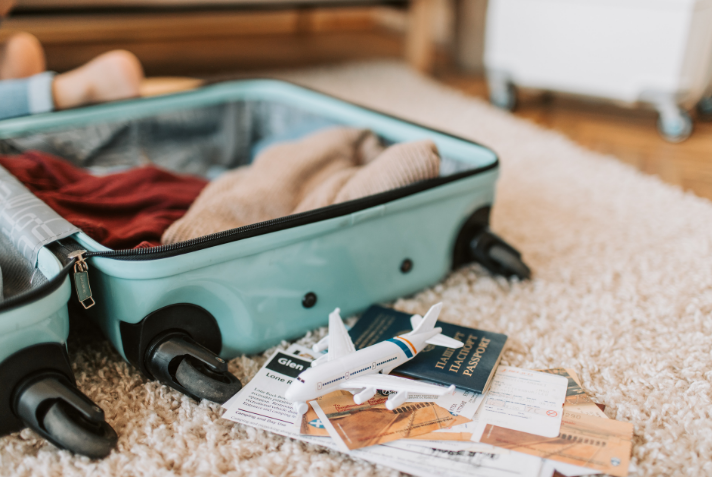
A helpful and customisable packing list can be found at Packlisten.org (in German!)
Our tip: When travelling by plane, train or bus, keep the following items in your hand luggage:
- Important documents (passport, visa, tickets, vaccination certificate, etc.)
- Valuables (jewellery, cash, debit/credit cards, laptop, etc.)
- A change of clothes
- A basic set of travel-sized toiletries
- Essential medication
This way, you’ll have the most important things with you in case your luggage gets lost.