Hochschule Karlsruhe Hochschule Karlsruhe - University of Applied Sciences
Moderne Industrieroboter in einer automatisierten Fertigungslinie – Symbolbild für intelligente Produktionstechnologien.

Institute for Robotics and Intelligent Production Systems

Profile

The IRP conducts research in the field of product-generating processes using intelligent systems at the interface between product development and production. Our research focuses on AI technologies, modern control algorithms, and the design of mechatronic systems. Our goal is to expand the autonomy and flexibility of today's production. Our topics are always characterized by their relevance for later application in industrial production. In order to play a decisive role in shaping the production of tomorrow, it is important to us to transform our research methods into innovative technologies.

Our mission: Research and teaching in the field of AI technologies for application in production engineering issues, particularly in the area of product-generating processes using intelligent systems.

Our vision: Securing and strengthening the competitiveness of production sites in high-wage countries through the use of intelligent production technologies.

Contact us

Institute Director
Prof. Dr.-Ing. Christian Friedrich
Phone: +49 (0) 721 925-1723
E-Mail: christian.friedrichspam prevention@h-ka.de

Location
Model Campus HKA 2030+
Technology Park (TP)
Building F, 1st floor
Wilhelm-Schickard-Straße 9
76131 Karlsruhe

Online

YouTube 

LinkedIn

GitHub

External content

To use this content (Source: www.xyz.de), please click to Accept. We would like to point out that by accepting this iframes data to third parties transmitted or cookies could be stored.

You can find further information in our Privacy policy.
Latest news

  • IRP-Doktorandenseminar 2026

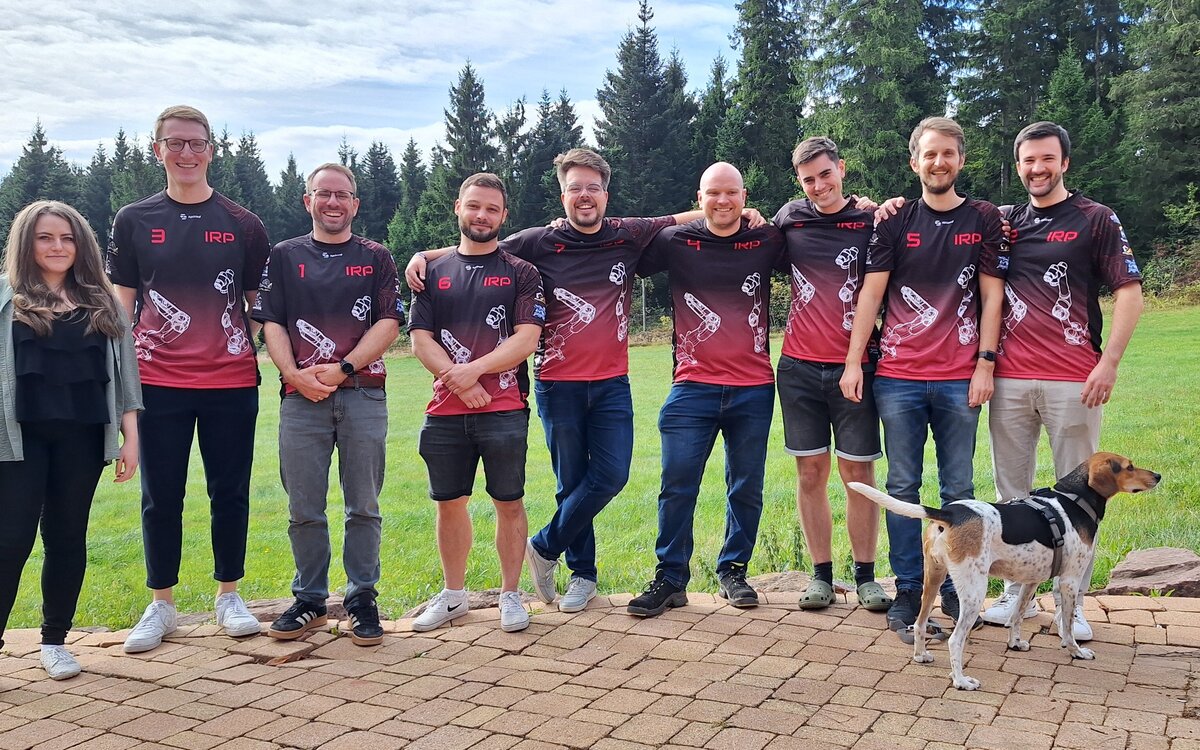
    For this year’s IRP doctoral seminar, we were in the beautiful Black Forest from September 20 to 22, 2026. The three-day conference focused primarily on our PhD students’ current research projects. From hybrid, learning-based identification methods to new planning algorithms for assembly and analog computer architectures for robot control - we were able to discuss the full range of our research in detail, critically examine it, and gain new insights for our future work.

    Now it’s time to integrate these insights into our research and tackle the next steps!

    Many thanks to everyone involved for the exciting discussions and the open scientific exchange!

  • Publication in the Journal of Intelligent Manufacturing 2026

    Our paper “Data-driven tool wear prediction in milling, based on a process-integrated single-sensor approach” has been published in the Journal of Intelligent Manufacturing.

    This paper examines the prediction of tool wear during milling using a single, easily integrable accelerometer. For modeling purposes, frequency representations are additionally generated from the time data using the Fourier transform. Subsequently, classical machine learning models and convolutional neural networks (CNNs) are evaluated with regard to predicting flank wear and classifying tool condition. In addition, the study analyzes how well the models can be transferred between two milling machines when training data is limited and varies.

    This work was part of the PATTERN project.

  • A Digital Twin Driven Modular Robotic Cell - CCPT 2026

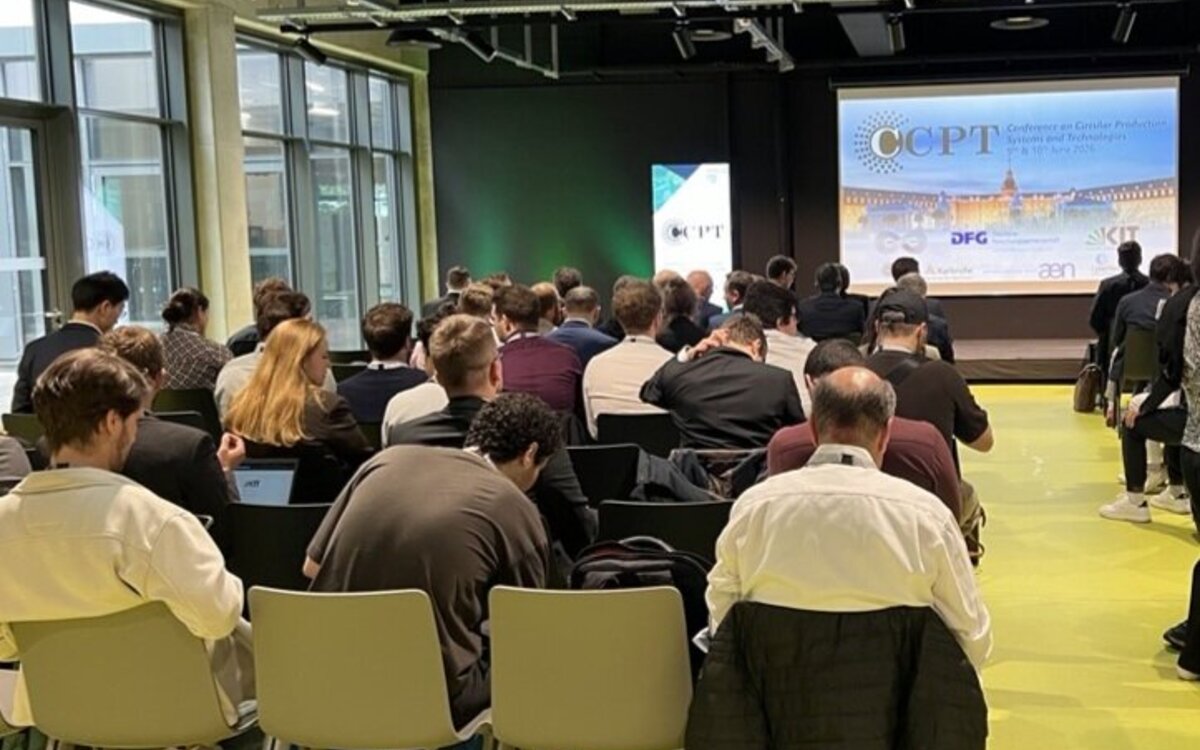
    As part of our collaboration with the IMP, our paper “A Modular Dual-Arm Robotic Cell for Disassembly and Repair of Industrial Control Electronics” was presented at the Conference on Circular Production Systems and Technologies (CCPT) in Karlsruhe on June 10, 2026.

    The paper presents a modular robotic cell for the disassembly and repair of industrial control electronics. It combines CAD-based disassembly planning with visual condition assessment and force-controlled robotic capabilities.

    The work was developed as part of the NewEra  project, funded by the Federal Ministry of Research, Space and Technology (BMFTR) within the funding measure "Digital GreenTech - environmental technology meets robotics" which contributes to the BMFTR Strategy “Research for Sustainability (FONA)“.

  • KickOff FEATHER

    Together with our partners SEW Eurodrive, SCHUNK, VisionTools, and the HKA institutes IDDS and IRAS, we are researching a standardized software platform for manufacturing companies that will enable federated learning for robotic manipulation across company boundaries. Robotic grasping and assembly are the main focus of research at the IRP.

    Many thanks to the Carl-Zeiss-Stiftung for funding the FEATHER (Federated Embodied AI Technology Harmonizing Efficient Robotics) project as part of the CZS Transfer program.

  • KickOff NewEra

    Three weeks ago we had a fruitful kick off from our new Project "Nachhaltige und wirtschaftliche Elektrogeräte Reparatur durch robotergestützte Automatisierung" (NewEra) at the  Federal Ministry of Research, Technology and Space in Berlin.

    It was an interesting start, especially to connect with the various project teams in the field of Digital Green Tech. We are delighted to be partnering with the Institute of Materials and Processes (HKA), Eichler GmbH, and EVT Eye Vision Technology GmbH to develop intelligent technologies for robot-based repairs. More information can be found here.

  • Presentation QBIT - IROS 2025

    The paper "QBIT: Quality-Aware Cloud-Based Benchmarking for Robotic Insertion Tasks" was presented by Constantin Schempp at the 2025 IEEE/RSJ International Conference on Intelligent Robots and Systems (IROS) in Hangzhou, China. This work was developed as part of the PIPE project

  • HKAs Intelligent robot technologies on television

    Yesterday, BadenTV visited the Institute of Robotics and Intelligent Production Systems (IRP). It was a good opportunity to present some of our current research topics!

    You can find the report here.

  • Presentation ARCC - ICRA 2025

    The paper "Highly dynamic physical interaction for robotics: design and control of an active remote center of compliance" was presented by Patrick Frank at the 2025 IEEE International Conference on Robotics & Automation (ICRA) in Atlanta, USA. This work was developed as part of the ISASDeMoRo project.

  • AI theme day

    On 22.01.2025 the AI theme day took place at the HKA. In his presentation "From data to actions - How do robots learn physical interaction?", Christian Friedrich presented current research topics from the IRP that show how robotic manipulation skills can be learned.

  • The IRP at ResearchContacts24

    The sensor-actuator system (SAS) developed in ISASDeMoRo was exhibited at HKA's ResearchContacts24 on November 7, 2024. This trade fair facilitates networking and information exchange among research institutes, companies, and other interested parties. The focus of the demos was on industrial use cases, such as mounting a component on a top-hat rail.

  • Presentation Robot Agnostic Visual Servoing - M2VIP 2024

    The paper "Robot Agnostic Visual Servoing" was presented by Constantin Schempp at the 30th IEEE International Conference on Mechatronics and Machine Vision in Practice (M2VIP) in Leeds, England. This work was developed as part of the ALPAKA project.

  • Presentation PIPE - CASE 2024

    The paper "PIPE: Process Informed Parameter Estimation, a learning based approach to task generalized system identification" was presented by Constantin Schempp at the 2024 IEEE 20th International Conference on Automation Science and Engineering (CASE) in Bari, Italy. This work is part of the ALPAKA project.

  • Research Day 2024 of the Baden-Württemberg Foundation

    The ISASDeMoRo project team was represented at the Baden-Württemberg Foundation's Research Day 2024 on June 25, 2024. There, interested visitors were able to learn about the advantages of the developed sensor-actuator system (SAS) and the major goal of autonomous assembly and disassembly by robot systems. Various demos were prepared for this purpose, allowing a direct comparison of classic force control and force control using the SAS.

  • Networking meeting CZS Research launch

    The first networking meeting "CZS Forschungsstart" took place in Mannheim and Ludwigshafen from 06.06. to 07.06.2024.
    In addition to the presentation of individual research projects and workshops, the program offered a great opportunity to get to know each other and network.

Projects Publications Team Career Equipment