Autonomous Robotics: From Simulation to Real-World Application
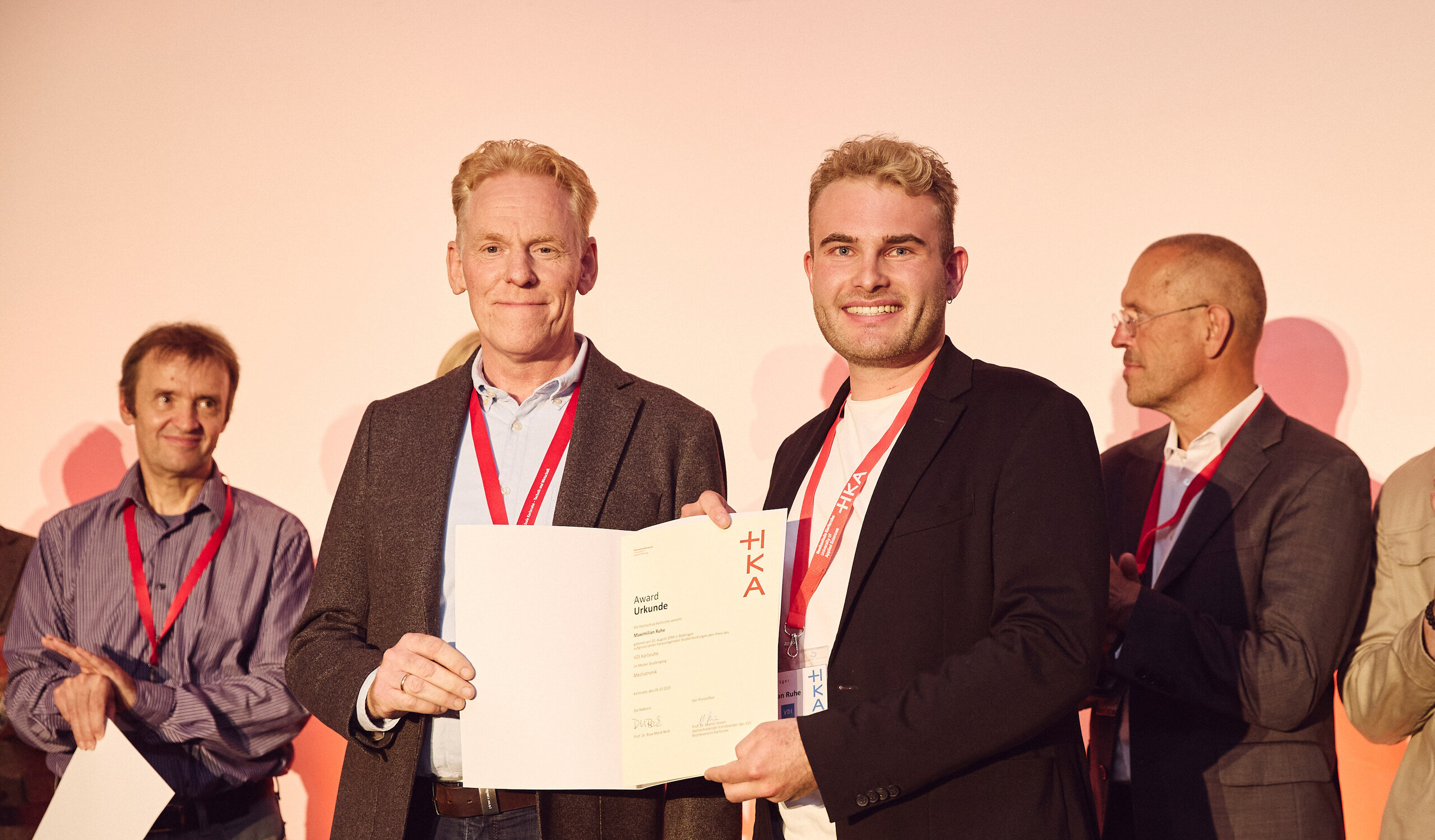
Maximilian Ruhe completed the master’s program in Mechatronics at the HKA. In his master’s thesis, he focused on a mobile robot platform that could be used, for example, to transport goods within a logistics warehouse. For this outstanding thesis, he received the award from the VDI Karlsruhe Chapter at our 2025 Academic Annual Ceremony. We asked Maximilian Ruhe a few questions about his thesis and his future career path.
HKA: Mr. Ruhe, your thesis focused on a mobile robot platform. Could you briefly explain what the topic was and what problem you solved?
Maximilian Ruhe (MR): My master’s thesis focused on an autonomous mobile robot that can be used, for example, in warehouse logistics. I further developed the platform’s hardware and software and integrated the various components into a ROS-2-based software architecture. Using various sensors, the robot can localize itself, map its environment, and detect obstacles.
One focus was on navigation and control. I investigated a specific model-based controller and compared it with various other approaches. The central question was: How can the robot move as efficiently and reliably as possible while simultaneously reacting to unpredictable obstacles such as people? In addition, I built a digital twin in NVIDIA Omniverse to first test and optimize the methods in simulation and then transfer them to the real robot.
What are the advantages of recreating the environment and the robot in such a simulation environment?
MR: The big advantage is that you can test a wide variety of things without having to use the actual robot every time. You can try out new algorithms, optimize parameters, and even test critical situations without putting the actual hardware at risk. This is particularly helpful for optimization methods because you can run the same sequence very often and automatically without having to constantly use the actual robot.
In addition, experiments can be reproduced very well in the simulation. This allows you to compare different approaches under exactly the same conditions. This is a major advantage, especially for data- and learning-based methods that require many iterations. The goal is to develop and optimize as much as possible virtually and then transfer the results to the actual robot—in other words, “sim-to-real.”
External content
To use this content (Source: www.xyz.de), please click to Accept. We would like to point out that by accepting this iframes data to third parties transmitted or cookies could be stored.
You can find further information in our Privacy policy.
How important are—or will become—such intelligent and autonomous robot platforms in today’s and tomorrow’s logistics?
MR: I think they will play a very significant role—and indeed already do—and are becoming increasingly commonplace in production and logistics environments. In logistics in particular, there are many repetitive transport tasks. Autonomous mobile robots can take on such tasks while simultaneously reacting flexibly to changes in their environment.
This is a major advantage over fixed automation solutions. Added to this are issues such as the shortage of skilled workers and the need to relieve workers of monotonous or physically demanding tasks.
What have you been doing since completing your master’s degree, and what is your doctoral research about?
MR: I’m currently working as a research assistant at the Institute of Materials and Processes and continue to focus intensively on robotics. Put simply, my doctoral research is about how robots can learn to move and interact with their environment based on various types of sensor data.
In my current project, for example, we’re working with two robotic arms designed to disassemble electronic devices as autonomously as possible, analyze the individual components, and then, if possible, perform repairs. The goal is to automate such processes more extensively, reuse defective devices and components in a more targeted manner, and thereby make repair, reuse, and recycling more economical and sustainable.
Do you think we’ll all eventually have autonomous robots at home that might not only vacuum but also cook and do laundry? And how long will that take?
MR: Yes, I’m actually convinced of that. For me, the question is more about when such robots will be reliable and cost-effective enough for widespread use. I also believe that humanoid robots will play an important role in this. Our entire environment is designed for humans. A robot with arms, hands, and human-like mobility can navigate this environment without us having to rebuild everything specifically for it.
Especially given demographic changes, I see great potential in household tasks, caregiving, and general support services. Robots could assist people in their daily lives and take on physically demanding tasks.
It will certainly take some time before a robot cooks, cleans up, and does the laundry as a matter of course. But I believe that we’ll first see more and more individual assistive tasks, and then the systems will gradually become more versatile. In my view, humanoid robots will definitely make their way into these areas.
Thank you very much, and I wish you continued success!