Motivation
Despite finite resources, the increasing demand for electronics is leading to ever greater quantities of electronic waste, while at the same time the useful life of many devices is decreasing. Repairs could make a significant contribution to reducing resource consumption, CO₂ emissions and waste, but are rarely carried out. The reasons for this are high repair costs, a lack of skilled personnel, a lack of availability of spare parts and a dwindling repair infrastructure. Although the EU "right to repair" provides for mandatory requirements in the future, the shortage of skilled workers and demographic change are exacerbating the situation. At the same time, many defects are highly repetitive and technically relatively simple, such as individual, non-functional electronic components. Intelligent, standardized and automatable solutions are therefore needed to make repairs more attractive, economical and scalable. Robotics offers great potential to reduce costs, increase throughput and stabilize repair processes in the long term, regardless of the labour market.
Overall goal
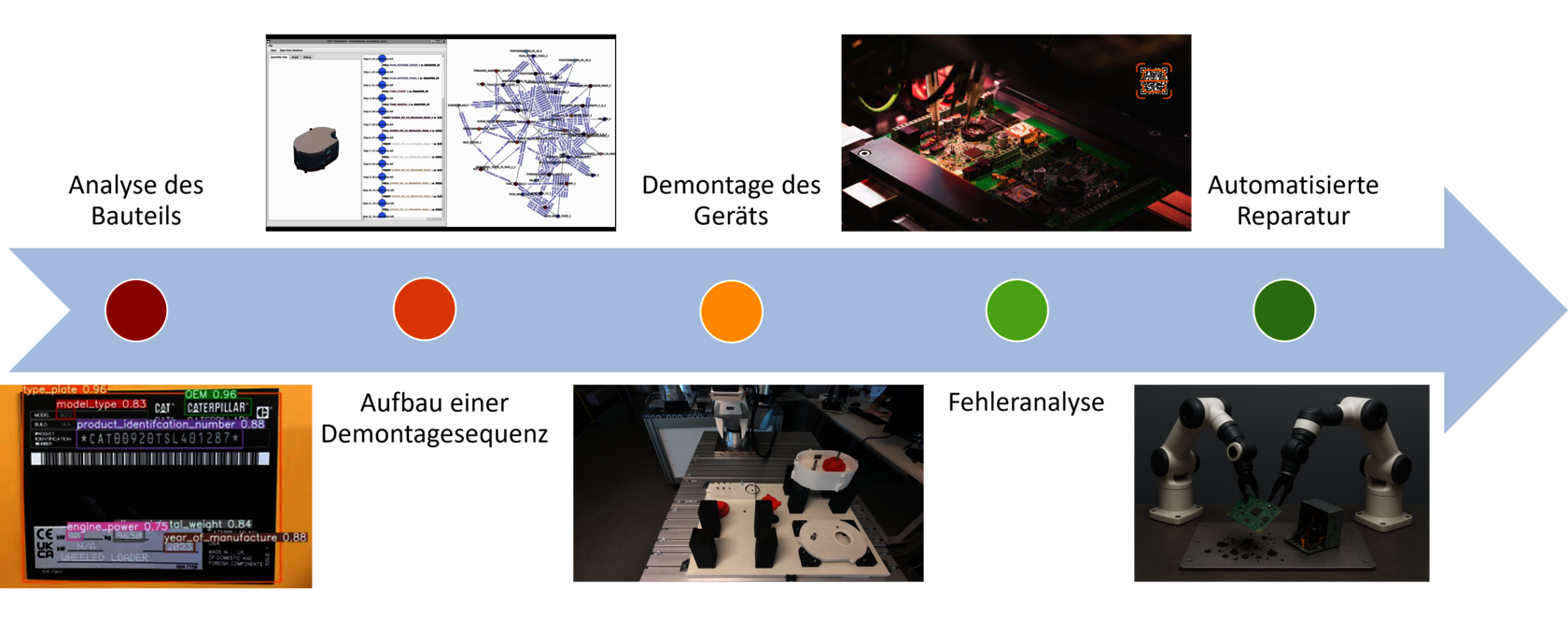
The aim of the project is to develop a methodology for the automated repair of electrical appliances and its prototypical implementation in a technology demonstrator. A robot-assisted system should be able to independently recognize, diagnose, rectify and document recurring fault patterns. Industrial reference products form the basis on which the complete repair workflow is implemented and tested. Finally, the demonstrator shows all the key process steps - from disassembly and diagnosis to functional testing - and forms the basis for the future establishment of automated repair solutions in a sustainable, circular value chain.
Methodology
A modular robot cell with a dual-arm manipulator, AI-supported fault diagnosis, adaptive gripper systems and flexible sequencing enables the automation of key repair steps. In addition, a scalable repair database is being created that maps expert knowledge in a structured manner. The results should be transferable to other industrial and consumer products and open up considerable ecological and economic savings potential.
Project funding
The NewEra project "Digital GreenTech - environmental technology meets robotics" is funded by the Federal Ministry of Research, Technology and Space (BMFTR ) as part of the "Research for Sustainable Development (FONA) " strategy and the "Naturally.Digital.Sustainable" action plan and is managed by the Karlsruhe Project Management Agency.