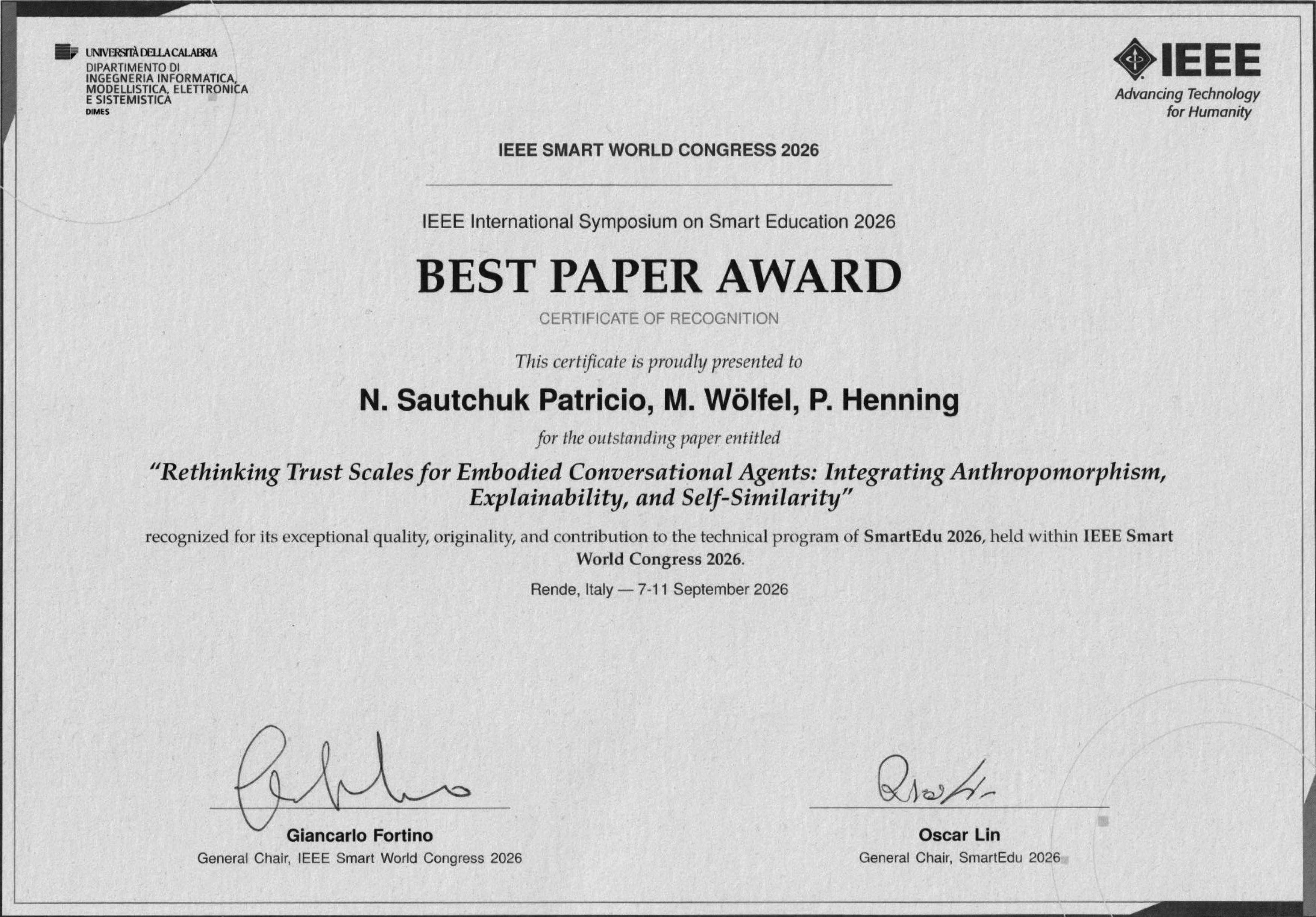

The Institute for Intelligent Interaction and Immersive Experience (IIIX) is pleased to announce a special honor: Nathalia Sautchuk-Patricio, Prof. Dr. Matthias Wölfel, and Prof. Dr. Peter Henning received the Best Paper Award from the IEEE International Symposium on Smart Education for their paper “Rethinking Trust Scales for Embodied Conversational Agents: Integrating Explainability, Anthropomorphism, and Self-Similarity.” The symposium took place from September 7 to 11, 2026, in Rende, Italy, as part of the IEEE Smart World Congress 2026. The award was presented at the conference’s gala dinner. The paper addresses trust in embodied conversational agents (ECAs). These are virtual, human-like assistants that combine speech, facial expressions, and gestures to enable conversations similar to those between humans. Existing scales for measuring trust often fail to adequately capture its complexity and neglect ECA-specific factors such as explainability, anthropomorphism, and self-similarity. Furthermore, trust scales have primarily been validated with adults, so their applicability to students has hardly been investigated to date.
To address this gap, the team conducted a study with 111 students who interacted with an ECA as part of a career orientation workshop. Statistical tests showed that the scale, developed specifically for this purpose, functions reliably and accurately reflects the collected data. The descriptive results were predominantly positive: The students rated the agent favorably overall and expressed a moderate level of trust in it. The study thus underscores the importance of incorporating ECA-specific dimensions into trust models.
The entire IIIX team, including Nathalia Sautchuk-Patricio, Prof. Dr. Matthias Wölfel, and Prof. Dr. Peter Henning, is delighted to receive this award.