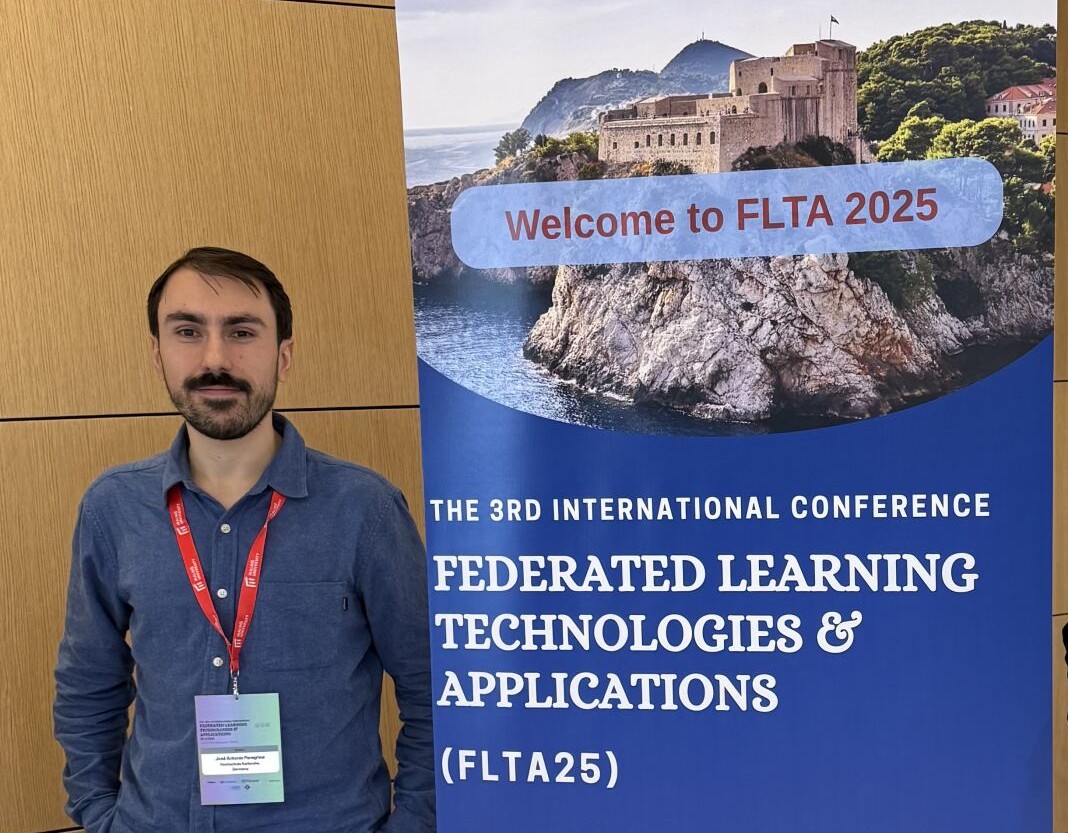
From October 14 to 16, 2025, José A. Peregrina from the IDSS group attended the International Conference on Federated Learning Technologies and Applications (FLTA 2025) in Dubrovnik, Croatia. The event brought together researchers and experts to discuss innovations in federated learning and related technologies. On October 15, José A. Peregrina presented the paper "A Platform to Integrate Data Governance in Federated Learning," co-authored by Guadalupe Ortiz and Christian Zirpins. The work addresses the challenge of embedding Data Governance mechanisms into Federated Learning workflows. The proposed platform provides support for negotiating the objectives and settings of the FL training process, executing the training while tracking participant contributions, and storing all provenance metadata generated throughout the process. The paper was published in the Proceedings of FLTA 2025 through IEEE at the end of February. For details please visit https://ieeexplore.ieee.org/document/11336572.
The platform itself is also openly available on GitHub as the FML-DG Platform repository
The presentation sparked engaging discussions with attendees, particularly regarding the platform's open availability, in a session full of interesting presentations. The conference provided a valuable opportunity for knowledge exchange and potential collaborations in the field of federated learning and data governance. More broadly, FLTA 2025 featured a range of presentations, discussions, and interactive sessions offering insights into the latest developments in federated learning technologies. The event underscored the importance of research in federated learning, as a way for improving Machine Learning mechanisms while respecting privacy restrictions.
This work is part of aura.ai, a project of the science offensive of the tri-national Upper Rhine metropolitan region, which is co-financed by the European Regional Development Fund (ERDF) as part of the Interreg Upper Rhine funding initiative. For more details please visit our webpage aura.ai